Industry News
SELECTED ITEMS OF INTEREST TO THE MEDIA COMMUNITY
What is the relationship of old school daytime soaps to binge watching to scrolling?
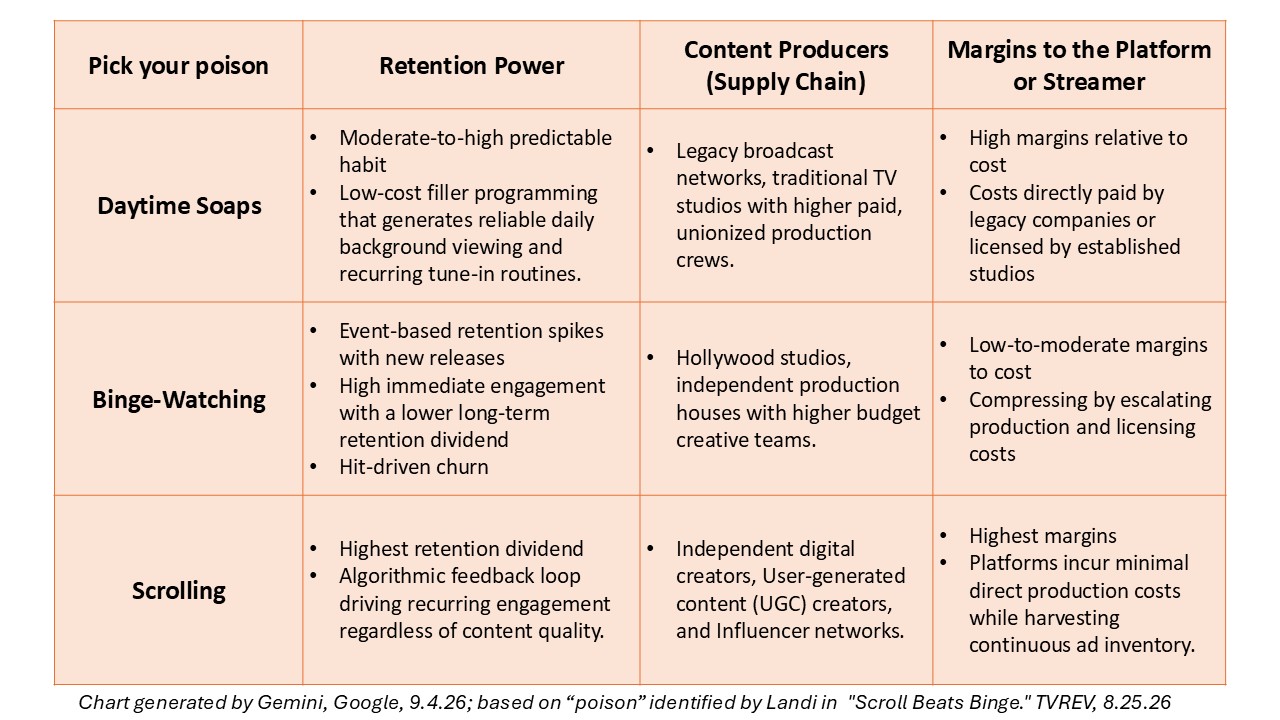
Substacker and former Disney and Fox executive Emanuele Landi has coined a succinct expression in his analysis connecting the viewer retention characteristics of old school daytime soaps, binge watching and scrolling. He boils down the insight to “Scroll beats binge.”
In pointing out that “scrolling delivers a higher retention dividend than binge-watching,” Landi makes clear why binge-watching kings Disney and Netflix have lately cut deals with YouTube and TikTok corporate and the creators that drive audiences on these social media.
Read the full story. Read more from Landi. And here.
#managementconsulting #mediastrategy
Corporate teams hire for cognitive diversity, but are terrible at harnessing its power
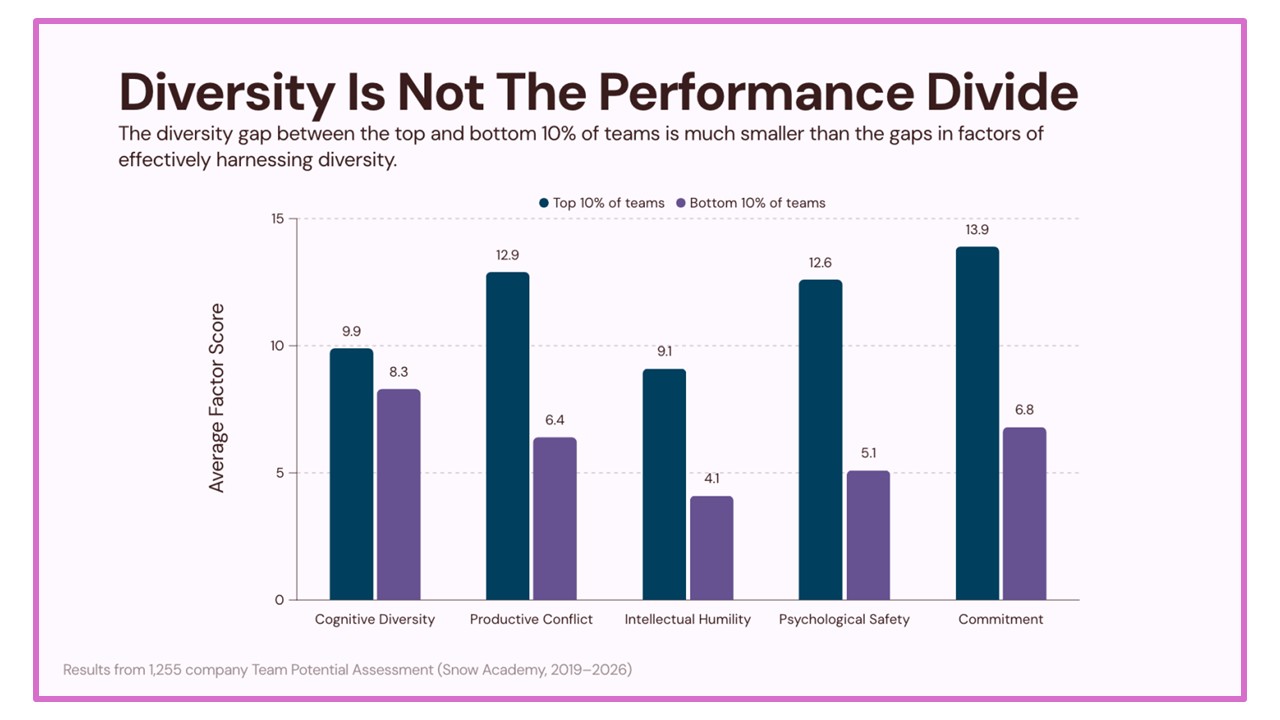
Shane Snow, author of Dream Teams, loves data. He is founder of the management skills training business Snow Academy and a serial entrepreneur in the media space. Based on results from his work with 1,225 corporate teams' self-assessments from 2019 to 2025, Snow has shared some striking findings in the just published The Team Potential Gap in Corporate America.
Snow has had teams self-score 9 factors: 4 Complex Teamwork factors that he developed through his work on Dream Teams plus 5 long-established ones.
Complex Teamwork factors
- Productive Conflict: Willingness to engage, dissent, & debate without getting personal
- Intellectual Humility: Willingness to revise viewpoints in light of new information
- Shared Purpose: Alignment on a superordinate goal & its “why”
- Shared Consciousness: Transparent, un-siloed knowledge sharing about the team and its resources
Table stakes Teamwork factors
- Trust and Commitment: Belief that others on the team are capable and will do what they say they will do
- Accountability: Willingness to take responsibility for team results
- Psychological Safety: Belief that others on the team will treat each other benevolently through conflict disagreement or risk-taking
Two of the report's detailed findings:
Cognitive diversity “is not currently the biggest bottleneck for team outcomes; it’s the ability to make use of diversity…that constrains most teams’ success.”
- “Sharpest cut of this whole study. Among cognitively-diverse teams, those with High Shared Consciousness have 39% higher Team Potential overall than teams with Low Shared Consciousness. A team cannot add up to more than the sum of its parts if it doesn’t know what its parts are.
Teams that have high levels of Productive Conflict (tolerance for dissent, frequency of team debates, ability to speak up with differing views) also score 15X to 20X scores on a majority of factors.
- “What I think is interesting about the study we did is we actually asked the deeper questions that add up to psychological safety [than standard studies], which paints a more real picture of what's actually going on,” said Snow by email. “Our results show that only 9-11% actually experience high psychological safety. About 66% score "moderate" and 25% score "low."
Read many more interesting findings in the full study here. Check out Snow’s newsletter here.
#managementconsulting #teamdevelopment
Rising opens, falling clicks: Reader engagement has become (one of) email’s deliverability firewalls
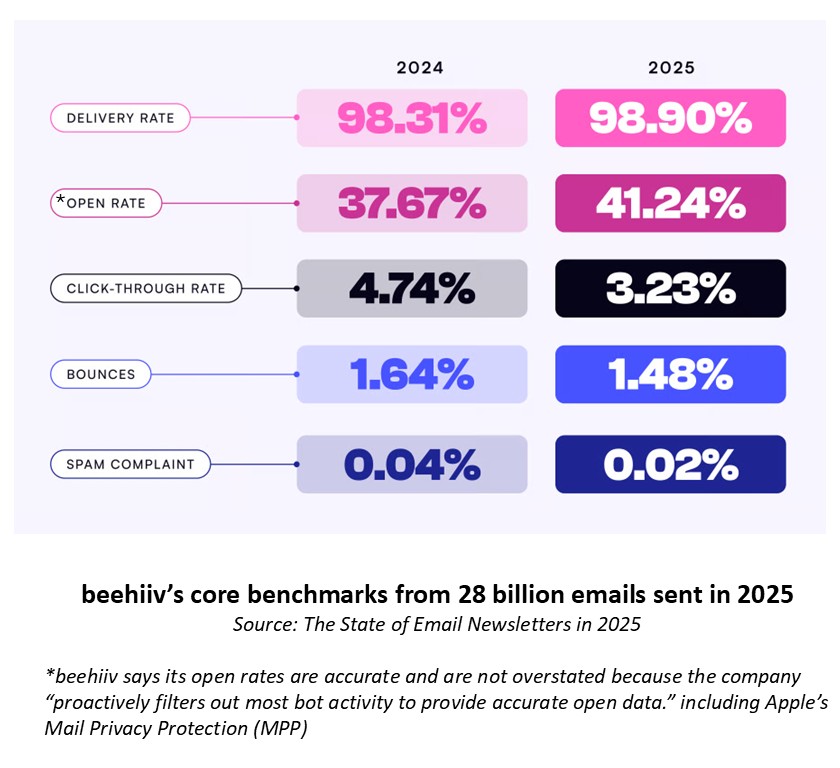
Useful metrics are periodically published by the newsletter platform beehiiv. We find these kind of details super helpful in comparing our clients' experience to outside norms. Since beehiiv is a very large player in the newsletter platform industry, we have faith that its statistics are reliable and representative. (Comparing beehive to its main competitors: beehiiv has ~68,000 active newsletters vs. Substack with ~200,000 vs. Ghost ~31,000.)
Here are highlights from beehiiv's recently published The State of Paid Newsletters 2026: Pricing, Conversion, and Retention Trends From Thousands of Paid Newsletters and the earlier The State of Newsletters 2026: Trends, Growth, and What’s Next for Email in 2026.
- Good news (opens) and bad news (clicks.) "More newsletters are being launched, and readers are opening them at higher rates.” But the click-through rate is down by more than a point (4.7% down to 3.2%.) beehiiv blames “competition,” somewhat amusingly, as it is essentially blaming itself for the lower engagement.
- Attention economy is here, ready or not. “[C]reators are entering the market at an unprecedented pace. As a result, attention, not access, has become the most competitive resource.”
- Normally secret conversion rates are shared. The median paid conversion from free to paid subs across beehiiv is about 0.6% (meaning for every 1,000 subscribers, about 6 are paying) but for the top 10% performers across all content categories, there is about a 12% conversion rate – that is 20X better than the median.
- Why the big gap between average and top? “Differentiation is driven less by scale and more by clarity, who the content is for, and why it exists.”
- “Reader engagement has become the new email deliverability firewall.” This means that email providers like Gmail now act like smart bouncers. They look directly at human behavior to decide who gets in, so if your subscribers consistently open your emails and click links, email providers mark you as a trusted, high-quality sender so future emails go straight to the inbox.
- Churn is a thing. Estimated subscriber lifetime for paid publications varies by industry, from the brief 6 months for “Money” to nearly 20 months for “News” and “Food & Drink.”
Read beehiiv's full (and detailed) articles here and here.
#managementconsulting #publishingmetrics #marketingconsulting


